Cow Math Puzzle: Are You Smart Enough to Solve the Viral Brain Teaser Everyone Gets Wrong?
Think you’re good at math? Try solving the famous cow math puzzle that confuses thousands of people online. Test your logic step by step.
You’ve probably seen it before.
A simple-looking cow puzzle shows up on social media with a caption like:
“Only geniuses can solve this.”
At first glance, it feels easy. Buy a cow. Sell the cow. Buy it again. Sell it again. Count the profit.
Done, right?
Not exactly.
What makes the cow math puzzle so addictive isn’t the arithmetic itself. It’s the way the human brain handles transactions, memory, and assumptions under pressure. People rush through the numbers, miss one tiny detail, and suddenly the comment section turns into chaos.
Some say the answer is $100. Others insist it’s $200. A few confidently argue for $0.
And somehow, everybody sounds certain.
That’s why this puzzle keeps going viral year after year. It’s not just a math problem — it’s a psychology test disguised as elementary arithmetic.
Today, we’re going to break down the famous cow math puzzle step by step, explain why so many people get it wrong, and show you how to sharpen your logic skills so you stop falling for misleading brain teasers.
By the end, you’ll not only know the correct answer — you’ll understand why your brain may have resisted it in the first place.
The Viral Cow Puzzle
Here’s the classic version:
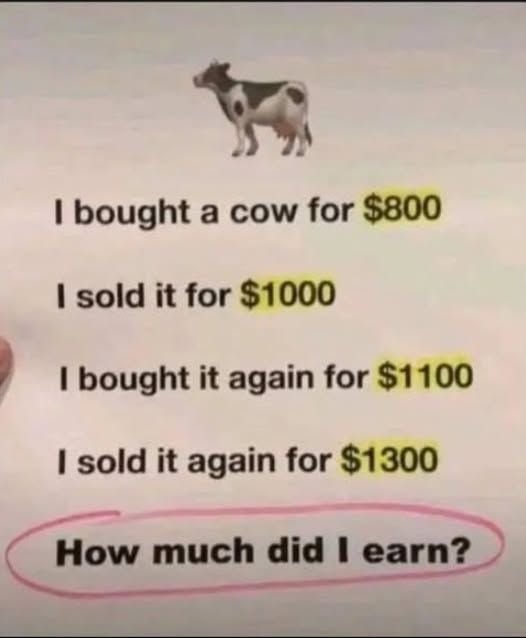
A farmer buys a cow for $800.
He sells it for $1,000.
Then he buys the cow back for $1,100.
Finally, he sells it again for $1,300.How much profit did he make?
Take a second before scrolling further.
Seriously.
Most people answer too quickly.
The Most Common Wrong Answers
Before solving it, let’s look at the mistakes people make.
Wrong Answer #1: $0
Some people think the second purchase “cancels out” the first profit.
It doesn’t.
Each transaction matters separately.
Wrong Answer #2: $500
This usually happens when someone subtracts:
- Bought for $800
- Sold for $1,300
Then mixes in the middle numbers incorrectly.
Wrong Answer #3: $100
This comes from partial math or skipping one transaction entirely.
Interestingly, many wrong answers happen because people try solving the puzzle mentally instead of organizing the information clearly.
That’s the trap.
The Correct Answer
The correct answer is:
$400 Profit
Here’s why.
First Transaction
- Buy cow for $800
- Sell cow for $1,000
Profit:
$1,000 − $800 = $200
So far:
+$200
Second Transaction
- Buy cow again for $1,100
- Sell cow again for $1,300
Profit:
$1,300 − $1,100 = $200
So now:
+$200 + $200 = $400
Final profit:
$400
Simple once you slow down.
But the puzzle becomes difficult because the brain naturally tries to combine all the numbers into one confusing sequence instead of treating each deal independently.
Why This Puzzle Tricks So Many Smart People
This is where things get fascinating.
The cow puzzle isn’t testing advanced mathematics. It’s testing cognitive discipline.
Your brain wants shortcuts.
When humans see multiple transactions quickly, we tend to:
- Compress information
- Skip steps
- Assume patterns
- Overcomplicate simple math
- Focus on the largest numbers emotionally
That’s why intelligent people often miss easy puzzles. Intelligence alone doesn’t prevent mental shortcuts.
Careful thinking does.
The Hidden Psychology Behind Brain Teasers
There’s a reason puzzles like this dominate Facebook, Reddit, TikTok, and YouTube Shorts.
They trigger three powerful psychological reactions:
1. Ego Challenge
The phrase:
“Only smart people can solve this”
instantly activates competitive thinking.
People want to prove themselves right.
2. Speed Pressure
Social media encourages fast reactions.
The quicker people answer, the more likely they are to make mistakes.
3. Public Commitment
Once someone comments an answer publicly, they become emotionally attached to it — even if it’s wrong.
That’s why online arguments about simple puzzles become surprisingly intense.
The Real Skill This Puzzle Tests
It’s not algebra.
It’s process thinking.
Strong problem-solvers usually:
- Break problems into pieces
- Track information carefully
- Avoid emotional assumptions
- Verify each step
- Ignore distractions
That skill matters far beyond puzzles.
It helps in:
- Business
- Investing
- Negotiation
- Budgeting
- Decision-making
- Contracts
- Data analysis
Ironically, people who rush because they “already know” often make more mistakes than beginners who move carefully.
A Simpler Way to Understand the Puzzle
Imagine two completely separate mini-business deals.
Deal 1
Bought for $800
Sold for $1,000
Profit = $200
Deal 2
Bought for $1,100
Sold for $1,300
Profit = $200
Now combine both profits:
$200 + $200 = $400
The confusion disappears immediately.
Sometimes the smartest thing you can do is simplify.
Why Viral Math Puzzles Explode Online
People love puzzles that feel:
- Easy at first
- Surprisingly tricky
- Debatable
- Shareable
The cow puzzle hits all four perfectly.
It also creates emotional tension because people hate realizing they made a mistake on “simple math.”
That emotional reaction drives comments and shares.
In other words:
the puzzle itself becomes entertainment.
Common Mistakes People Make While Solving It
Combining All Numbers Into One Equation
This often creates unnecessary confusion.
Ignoring Separate Transactions
Each buy/sell cycle has its own profit.
Rushing to Answer
Fast thinking is useful sometimes — but dangerous in logic puzzles.
Letting Bigger Numbers Distract You
People emotionally focus on:
- $1,100
- $1,300
instead of tracking actual gains and losses step by step.
The Best Strategy for Solving Any Math Puzzle
If you want to improve at puzzles like this, use a simple system.
Step 1: Slow Down
Most mistakes happen in the first 10 seconds.
Step 2: Write Everything Clearly
Visual organization reduces mental overload.
Step 3: Separate Events
Treat each transaction independently.
Step 4: Ignore Emotional Reactions
The puzzle wants you to panic slightly.
Don’t.
Step 5: Double-Check
Smart people verify their answers.
Overconfident people usually don’t.
Another Version of the Cow Puzzle
Here’s a variation that also confuses people:
A farmer buys a cow for $500.
He sells it for $700.
Then buys it again for $800.
Finally sells it for $1,000.What’s the total profit?
Let’s solve it.
First profit:
$700 − $500 = $200
Second profit:
$1,000 − $800 = $200
Total:
$400
Notice the pattern?
Every version works the same way.
What This Puzzle Reveals About Human Thinking
The internet loves calling puzzles “IQ tests,” but most viral puzzles actually measure something more specific:
Attention Control
Can you stay focused without jumping ahead?
Mental Organization
Can you structure information properly?
Impulse Resistance
Can you resist blurting out the first answer that feels right?
These skills matter in real life more than memorizing formulas.
A Mini Story: How One Tiny Mistake Changes Everything
Picture this.
Jake sees the cow puzzle during lunch break. He glances at it for five seconds and confidently says:
“The answer is $200.”
His coworker disagrees immediately.
Now Jake has two choices:
- Recalculate carefully
- Defend his first answer emotionally
Most people instinctively choose defense first.
That’s human psychology.
Our brains protect ego before accuracy.
The strongest thinkers learn how to pause and reassess without feeling threatened by being wrong.
That habit alone can improve decision-making dramatically.
Why Teachers Love Puzzles Like This
Simple puzzles reveal how students think under pressure.
A math teacher can quickly see:
- Who rushes
- Who organizes information
- Who checks work
- Who guesses
- Who panics under complexity
And interestingly, students who carefully show steps often outperform naturally “fast” students over time.
Precision beats speed surprisingly often.
The Internet’s Obsession With “Gotcha” Puzzles
There’s a reason these puzzles never disappear.
They create instant engagement because they combine:
- Curiosity
- Competition
- Frustration
- Surprise
- Ego
That emotional mix keeps people scrolling.
Social media algorithms love content that sparks arguments because comments increase visibility.
So every few months, another version of the cow puzzle reappears and starts the cycle all over again.
Pros and Cons of Viral Brain Teasers
| Pros | Cons |
|---|---|
| Improves critical thinking | Can encourage overconfidence |
| Sharpens attention to detail | Some puzzles are intentionally misleading |
| Fun social activity | Comment arguments get toxic fast |
| Exercises mental discipline | People confuse puzzles with intelligence tests |
| Encourages logical reasoning | Viral captions exaggerate difficulty |
The healthiest approach is to treat puzzles as mental exercise — not proof of superiority.
Expert-Level Tip: Watch for “Narrative Distraction”
Advanced puzzle creators often hide simple math inside stories.
The story distracts your working memory.
That’s exactly what happens here:
- Buy
- Sell
- Buy again
- Sell again
The repeated actions create unnecessary mental clutter.
Experts learn to strip away the story and isolate the structure underneath.
Once you do that, most puzzles become dramatically easier.
2026 Trend: Why Brain Teasers Are Becoming More Popular Again
Attention spans are shrinking, but interest in “micro-learning” content is exploding.
Short puzzles fit perfectly into:
- TikTok clips
- Instagram posts
- YouTube Shorts
- Facebook debates
People enjoy quick mental challenges because they provide:
- Instant feedback
- Small dopamine rewards
- Social interaction
- Competitive satisfaction
In a strange way, viral puzzles became modern digital campfires where strangers gather to argue about logic.
Frequently Asked Questions
What is the correct answer to the cow math puzzle?
The correct answer is usually $400 profit in the classic version.
Why do people get the puzzle wrong?
Most people rush and fail to separate the two transactions.
Is this puzzle testing IQ?
Not really. It mainly tests attention, organization, and careful reasoning.
Are viral math puzzles intentionally confusing?
Many are designed to create quick mistakes for engagement.
What’s the easiest way to solve puzzles like this?
Break every transaction or step into separate parts.
Do smart people fall for these puzzles too?
Absolutely. Intelligence doesn’t eliminate cognitive shortcuts.
Why do online comments argue so much about simple puzzles?
People become emotionally attached to their first answer.
Are these puzzles good for the brain?
Yes, when approached as mental exercise rather than ego competition.
What skill matters most in solving brain teasers?
Patience and structured thinking.
Can kids solve this puzzle?
Yes. The math itself is simple enough for many elementary students once organized clearly.
Quick Action Checklist
Do This
✔ Slow down before answering
✔ Separate each transaction clearly
✔ Write numbers step by step
✔ Double-check assumptions
✔ Focus on logic, not speed
✔ Treat mistakes as learning opportunities
Avoid This
✘ Guessing too quickly
✘ Combining unrelated steps
✘ Letting big numbers confuse you
✘ Defending wrong answers emotionally
✘ Assuming “easy-looking” means easy
✘ Rushing because others answered fast
The cow math puzzle became famous for one simple reason:
It exposes how easily the human brain can trip over small details.
And honestly, that’s useful.
In real life, tiny misunderstandings can affect money, contracts, decisions, relationships, and opportunities. Learning to slow down, organize information, and think clearly under pressure is a skill worth practicing.
Even if it starts with a cow puzzle on Facebook.
So the next time a viral brain teaser pops up in your feed, don’t rush to prove how smart you are.
Pause.
Break it down.
Then solve it carefully.
That’s usually where the real intelligence shows up.
The cow puzzle isn’t difficult because the math is hard. It’s difficult because people rush, overthink, and skip logical steps. Careful thinking beats fast guessing almost every time.
Think your friends can solve it? Share this article, compare answers, and see who actually slows down enough to get it right.