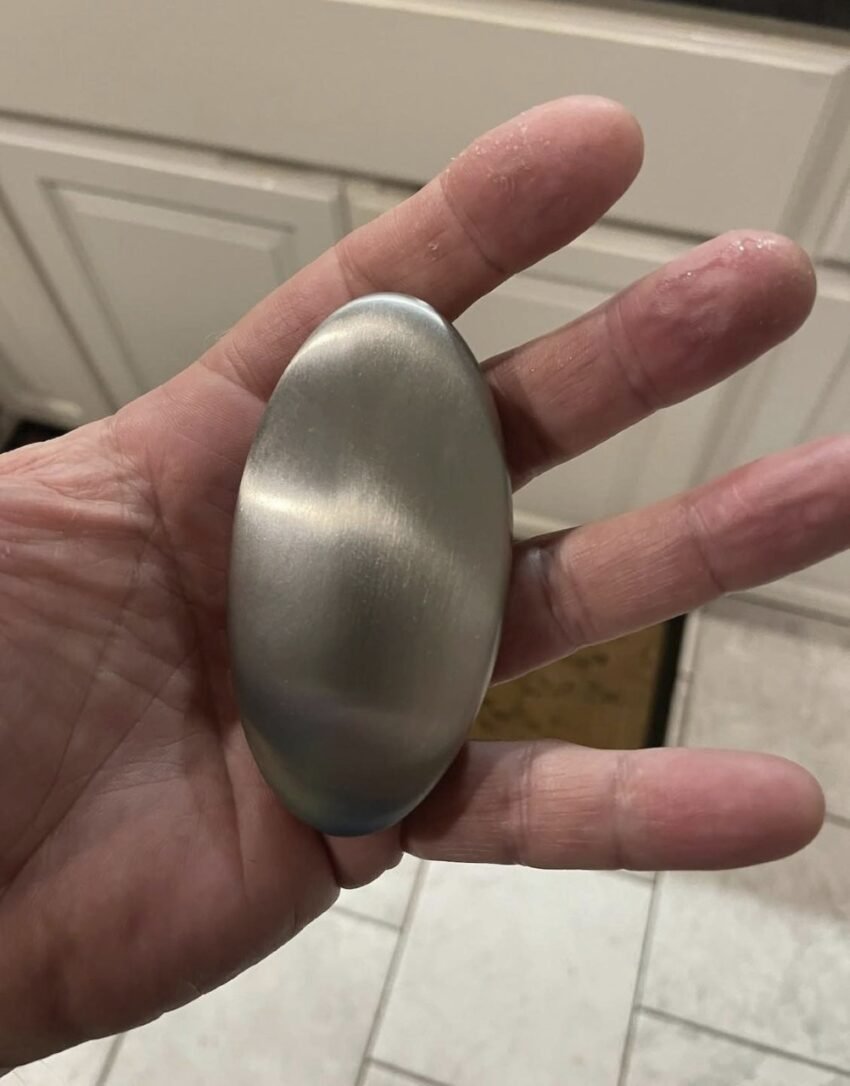
That Metal “Soap” by the Sink — The Strange Science Behind Stainless Steel’s Odor-Removing Magic
Why does stainless steel “soap” remove garlic, onion, and fish smells from your hands? Here’s the real science behind the viral kitchen trick.
You finish chopping garlic.
Or onions. Or salmon.
You wash your hands once. Twice. Maybe three times. And somehow the smell is still there — haunting your fingers like a bad decision.
Then someone hands you… a piece of metal.
Not soap. Not detergent. Just a smooth stainless steel bar shaped like a soap puck.
You rub it under cold water, fully expecting absolutely nothing to happen.
And yet somehow, the smell fades.
Not completely imaginary. Not magic. Not exactly a gimmick either.
That strange chunk of steel sitting beside kitchen sinks has become one of the internet’s favorite “weird but weirdly effective” household tools. But what’s fascinating is that even chemists still debate exactly how well it works — and why.
Because stainless steel soap sits in a strange category of everyday objects:
- too simple to seem believable,
- too widely used to dismiss entirely,
- and backed by just enough chemistry to make the mystery more interesting.
So what’s actually happening when you rub stainless steel on smelly hands?
The answer involves sulfur compounds, surface chemistry, human perception, and a little bit of kitchen folklore that turned out to contain real science.
What Is Stainless Steel “Soap,” Exactly?
Stainless steel soap is usually a bar-shaped piece of stainless steel designed to mimic regular soap.
You use it similarly:
- Run cold water over your hands
- Rub the steel between your fingers and palms for 20–40 seconds
- Rinse
That’s it.
No suds. No fragrance. No visible reaction.
Which is partly why people become obsessed with it. It feels counterintuitive. Humans are conditioned to associate cleanliness with foam, scent, and visible product use.
A silent metal bar doing the job instead feels suspiciously like kitchen mythology.
Yet stainless steel odor removers have been sold for decades and remain surprisingly popular in American kitchens, especially among people who cook frequently with:
- Garlic
- Onions
- Fish
- Shellfish
- Certain cheeses
- Strong spices
The common thread? Sulfur-containing compounds.
And that’s where the chemistry starts getting interesting.
Why Garlic and Fish Smells Stick to Your Hands in the First Place
The smell isn’t just “on” your skin.
It’s interacting with it chemically.
Garlic, onions, and fish release volatile sulfur compounds — tiny airborne molecules with extremely strong odors. Humans are remarkably sensitive to sulfur smells because evolution trained us to notice things associated with spoilage, toxicity, or bacterial activity.
Garlic alone contains compounds like:
- Allicin
- Allyl methyl sulfide
- Diallyl disulfide
Fish odors often involve:
- Trimethylamine
- Sulfur derivatives from decomposition processes
These molecules cling stubbornly to skin oils and microscopic surface textures on your hands.
Regular soap helps by:
- Breaking up oils
- Lifting odor molecules
- Washing residues away
But some sulfur compounds are notoriously persistent. They bind strongly and continue releasing odor even after washing.
That lingering scent isn’t always leftover food particles.
Sometimes it’s chemistry happening directly on your skin.
So How Does Stainless Steel Remove Odors?
Here’s the widely accepted theory:
The stainless steel interacts with sulfur-containing molecules, helping transfer or neutralize them through a catalytic surface reaction.
In simpler terms:
- sulfur compounds stick to the steel surface,
- the metal may help rearrange or bind them,
- and water washes them away.
The exact mechanism remains debated, but the chemistry isn’t completely made up.
Stainless steel contains metals like:
- Iron
- Chromium
- Nickel
These metals form an oxide layer on the steel’s surface. Some researchers believe sulfur molecules bind weakly to this layer, reducing their presence on skin.
Another possibility is electron transfer reactions occurring between sulfur compounds and the metal surface.
What’s important is this:
The effect appears strongest with sulfur-based odors specifically.
That’s why stainless steel soap tends to work better for:
- Garlic
- Onion
- Fish
…and much less effectively for:
- Perfume
- Smoke
- Gasoline
- Sweat odors
Different smells come from different chemical families.
Stainless steel isn’t a universal odor eraser.
The Cold Water Detail Isn’t Random
Most stainless steel soap instructions recommend cold water.
That’s not marketing fluff.
Warm water opens pores and increases volatility, which can actually intensify odor perception temporarily. Cold water helps keep sulfur compounds from becoming more airborne while you rinse them away.
Professional chefs often use the same trick after handling seafood.
There’s also another subtle factor:
cold water preserves skin oils differently, which may help prevent sulfur compounds from spreading deeper across the skin surface during washing.
Small detail. Big difference.
Does Stainless Steel Soap Actually Work — Or Is It a Placebo?
This is where things get nuanced.
Some people swear by it.
Others say it’s nonsense.
The reality probably sits somewhere in the middle.
Several factors complicate testing:
- Human smell perception varies enormously
- Expectations influence odor detection
- Running water alone removes some odor
- Mechanical rubbing helps regardless of material
But controlled demonstrations have shown that stainless steel can reduce certain sulfur odors measurably under the right conditions.
The strongest evidence tends to involve garlic and onion handling.
One reason debate continues is that odor reduction is hard to quantify psychologically. Humans adapt quickly to smells. After a few minutes, your brain partially stops noticing them.
That means:
- some people overestimate effectiveness,
- while others underestimate it.
Interestingly, many chefs and food professionals continue using stainless steel odor removers despite understanding basic chemistry well.
That persistence suggests there’s likely something real happening beyond pure placebo.
Why Stainless Steel Specifically?
Not all metals work equally.
Stainless steel matters because:
- it resists corrosion,
- remains chemically stable,
- forms a chromium oxide surface layer,
- and safely contacts skin and food.
Reactive metals like copper or aluminum could create unwanted chemical interactions or discoloration.
Stainless steel occupies a useful middle ground:
stable enough to use safely,
active enough at the surface to interact with sulfur compounds.
That passive oxide layer is the key.
Ironically, stainless steel’s resistance to rust is also what makes it useful here.
The Weird Kitchen Hack That Accidentally Predicted the Product
Before stainless steel soap became a marketed product, cooks discovered the trick accidentally.
People noticed that rubbing hands on:
- stainless sinks,
- faucets,
- spoons,
- or countertops
sometimes reduced garlic smells after cooking.
Eventually manufacturers realized:
“If people are already rubbing their hands on kitchen fixtures… why not turn that into a product?”
And honestly, it’s one of the smarter kitchen product ideas of the past few decades because it solves a real annoyance with:
- no chemicals,
- no waste,
- no expiration date,
- and essentially infinite reuse.
That’s rare.
Why Strong Odors Trigger Such Intense Reactions in Humans
This part goes deeper than kitchen convenience.
Humans are biologically wired to react strongly to sulfur smells.
From an evolutionary perspective, sulfur-like odors often signaled:
- Rotting food
- Dangerous bacteria
- Contamination
- Toxins
- Poor hygiene
Your brain treats sulfur compounds as important survival information.
That’s why garlic on your fingers can feel oddly “sticky” psychologically even when the smell is faint.
The brain prioritizes those molecules.
There’s also a social factor:
people worry others can smell what they smell.
That anxiety makes lingering odors feel even more persistent.
Which partly explains why stainless steel soap became such a fascinating object culturally. It promises to solve a very human discomfort in an almost magical way.
When Stainless Steel Soap Works Best
Results improve dramatically when used correctly.
Best Practices:
- Use cold running water
- Rub thoroughly for 30 seconds
- Focus on fingertips and nails
- Wash immediately after handling odor-causing foods
- Use real stainless steel, not coated metal
The timing matters more than many people realize.
Fresh sulfur compounds are easier to remove before they settle into skin oils deeply.
When It Doesn’t Work Well
This is where marketing claims sometimes overreach.
Stainless steel soap is not effective against every smell.
It struggles with:
- Smoke residue
- Synthetic fragrances
- Oil-based industrial odors
- Skunk spray
- Chemical solvents
That’s because these odors involve completely different molecular structures.
Sulfur-targeted surface chemistry won’t solve everything.
And if your hands are physically greasy, actual soap is still necessary first.
Real-World Kitchen Scenario
Imagine someone preparing:
- garlic butter shrimp,
- caramelized onions,
- and fresh salmon filets.
That’s essentially a sulfur compound perfect storm.
After cooking, regular soap removes surface oils but leaves faint odor traces behind.
The person then rubs stainless steel under cold water for 20–30 seconds.
What likely happens:
- residual sulfur compounds transfer or weaken at the steel surface,
- remaining molecules dilute under running water,
- odor perception drops significantly.
Not necessarily to zero.
But often enough to notice.
That distinction matters because people expecting “complete odor annihilation” may feel disappointed, while those expecting partial odor reduction are usually impressed.
The Psychology Behind Why This Product Went Viral
Stainless steel soap hits a rare sweet spot online:
- visually strange,
- scientifically plausible,
- cheap,
- reusable,
- easy to demonstrate.
It creates immediate curiosity because it violates expectation.
Humans instinctively think:
“Soap should foam.”
“Metal shouldn’t clean smells.”
“There has to be a trick.”
That cognitive tension makes the product highly memorable.
It also taps into another powerful psychological effect:
people love low-tech solutions that outperform complicated ones.
A simple metal bar solving a frustrating problem feels oddly satisfying in an era dominated by disposable chemical products.
Common Mistakes People Make
Mistake #1: Expecting It to Replace Soap
It’s an odor-removal tool, not a sanitizer.
You still need actual soap for hygiene.
Mistake #2: Using Warm Water
Warm water can intensify volatile smells.
Cold water usually works better.
Mistake #3: Buying Cheap Coated Imitations
Some novelty versions aren’t genuine stainless steel.
Surface composition matters.
Mistake #4: Expecting Instant Perfection
Odor reduction varies based on:
- skin chemistry,
- food type,
- exposure level,
- and sensitivity to smell.
Mistake #5: Waiting Too Long
Fresh residues are easier to remove.
The Environmental Angle Nobody Talks About
This is quietly one of the most sustainable kitchen products around.
Think about it:
- no packaging waste after purchase,
- no refills,
- no chemicals entering wastewater,
- no expiration date,
- virtually permanent lifespan.
In a culture built around disposable cleaning products, stainless steel soap is almost absurdly low-impact.
One small bar can last decades.
That’s part of its appeal in 2026, especially as more consumers look for reusable household tools.
Can You Just Use Your Kitchen Sink Instead?
Honestly… yes.
If your sink or faucet is genuine stainless steel, rubbing your hands on it under cold water may produce similar effects.
The standalone “soap bar” mainly exists for:
- convenience,
- portability,
- ergonomics,
- and dedicated use.
The chemistry doesn’t care whether the steel is shaped like soap.
That realization surprises a lot of people.
The Science Debate: What Researchers Still Don’t Fully Agree On
This is where the topic becomes genuinely fascinating.
Scientists still debate:
- whether catalytic reactions are the main mechanism,
- whether simple adsorption explains most effects,
- or whether water and friction account for more than expected.
Some evidence suggests sulfur compounds bind weakly to chromium oxide layers.
Other researchers argue the effect is overstated psychologically.
Both can be partially true simultaneously.
What’s important is that:
- sulfur odors do appear reduced in many cases,
- but the exact chemistry remains less settled than product marketing implies.
That uncertainty actually makes the phenomenon more interesting, not less.
Because sometimes everyday life reveals effects people discovered experimentally long before science completely explained them.
Stainless Steel Soap vs Regular Soap
| Feature | Stainless Steel Soap | Traditional Soap |
|---|---|---|
| Removes bacteria | No | Yes |
| Targets sulfur odors | Yes | Partially |
| Reusable | Essentially forever | No |
| Produces lather | No | Yes |
| Requires chemicals | No | Usually |
| Works on grease | Limited | Excellent |
| Eco-friendly | Very high | Moderate |
| Best use case | Odor neutralization | General cleaning |
2026 Trends: Why Stainless Steel Kitchen Tools Are Growing Again
There’s been a noticeable shift toward:
- reusable kitchen products,
- minimalist cleaning tools,
- low-waste household items,
- and “grandparent-era hacks” backed by science.
Social media accelerated interest in:
- cast iron cookware,
- vinegar cleaning methods,
- wooden kitchen tools,
- and stainless steel odor removers.
People are becoming more skeptical of over-engineered products with exaggerated claims.
A small steel bar that quietly solves a real problem feels refreshingly honest.
That authenticity matters more now than it did a decade ago.
Frequently Asked Questions
Does stainless steel soap really work?
For many sulfur-based food odors like garlic, onion, and fish, yes — at least partially. Results vary depending on the person and the odor type.
Why does garlic smell stay on hands so long?
Garlic contains sulfur compounds that bind stubbornly to skin oils and continue releasing odor molecules over time.
Can stainless steel remove fish smell?
It often helps reduce fish odors, especially when used immediately after handling seafood under cold water.
Is stainless steel soap antibacterial?
No. It is not a replacement for regular hand soap or proper hygiene.
Why does cold water work better?
Cold water reduces volatility of odor compounds and may help prevent smells from intensifying during washing.
Can I use a stainless steel sink instead?
Usually yes, provided it’s genuine stainless steel.
Does stainless steel soap wear out?
Not under normal use. Since it relies on surface properties rather than chemical depletion, it can last for years or decades.
Why do some people think it’s fake?
Because the effect can be subtle, psychological odor adaptation complicates perception, and water alone already removes some odor.
Does it work on perfume or smoke smells?
Not very well. It’s most effective on sulfur-based food odors.
Is there scientific proof behind it?
There’s credible chemistry supporting the idea, though researchers still debate the exact mechanisms and overall effectiveness.
Quick Action Checklist
What To Do
✔ Use cold water
✔ Rub for at least 20–30 seconds
✔ Focus on fingertips and nails
✔ Use immediately after cooking
✔ Pair with regular soap when needed
✔ Buy genuine stainless steel
What To Avoid
✘ Expecting it to sanitize hands
✘ Using warm water
✘ Waiting hours after handling food
✘ Assuming all odors respond equally
✘ Buying coated novelty versions
That strange metal “soap” beside the kitchen sink isn’t magic.
But it’s not nonsense either.
Stainless steel appears to interact with sulfur-based odor molecules in a way that helps reduce lingering smells from foods like garlic, onions, and fish. The chemistry is real enough to matter — even if science still debates the finer details.
And maybe that’s part of the appeal.
In a world overflowing with disposable products and exaggerated promises, there’s something oddly satisfying about a simple piece of metal quietly doing its job decade after decade.
No batteries. No fragrance. No subscription.
Just chemistry, water, and one of the strangest little kitchen tricks that actually seems to work.
👉 Ever tried stainless steel soap yourself? Share whether it worked for you — or which kitchen smell refuses to leave your hands no matter what you do.