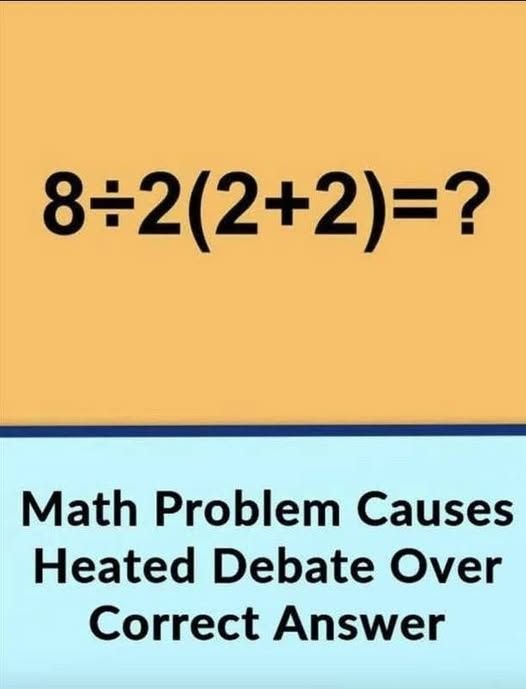
This “Simple” Math Problem Sparked Massive Debate — Here’s Why People Can’t Agree on the Answer
A viral math problem has people arguing over the correct answer. Learn why confusion happens and how to solve it correctly.
It looks harmless at first glance.
A short line of numbers. A few basic operations. Nothing you haven’t seen since middle school.
And yet—millions of people argue over it.
Different answers. Heated debates. Confident explanations… all contradicting each other.
So what’s going on?
Why does a basic math problem turn into a full-blown controversy?
The answer isn’t just math—it’s how we interpret math.
Let’s break it down in a way that finally makes sense.
The Problem That Starts the Argument
Here’s a classic version of the viral equation:
8 ÷ 2(2 + 2)
Take a second. What answer do you get?
Some people confidently say 1.
Others are just as sure it’s 16.
Both sides believe they’re right—and that’s where things get interesting.
Why This Problem Confuses So Many People
At the core of the debate is a misunderstanding of order of operations.
Most people learned it as:
- PEMDAS (Parentheses, Exponents, Multiplication, Division, Addition, Subtraction)
But here’s the detail many forget:
👉 Multiplication and division are handled left to right
👉 They are equal in priority
This single detail is where the disagreement begins.
Step-by-Step: Solving It the Right Way
Let’s go through it carefully.
Problem:
8 ÷ 2(2 + 2)
Step 1: Solve the parentheses
2 + 2 = 4
Now the equation becomes:
8 ÷ 2(4)
Step 2: Handle division and multiplication (left to right)
This is the key step.
Rewrite it clearly:
8 ÷ 2 × 4
Now go left to right:
- 8 ÷ 2 = 4
- 4 × 4 = 16
👉 Final Answer: 16
So Why Do Some People Get 1?
Because they interpret the expression differently.
Some read:
2(4) as a tightly bound unit
So they treat the equation like:
8 ÷ [2(4)] = 8 ÷ 8 = 1
This comes from older notation styles where multiplication written next to parentheses implied stronger grouping.
But in modern standard math rules, that’s not how it works unless brackets are explicitly added.
The Real Problem: Ambiguous Notation
Here’s the truth:
👉 The equation itself is poorly written.
It lacks clarity.
In professional mathematics, this would usually be written as either:
- 8 ÷ (2 × (2 + 2)) → equals 1
or - (8 ÷ 2) × (2 + 2) → equals 16
Without clear grouping, confusion is inevitable.
Why This Keeps Going Viral
These problems spread because they trigger:
- Confidence (“This is easy”)
- Surprise (“Wait, what?”)
- Debate (“You’re wrong”)
It becomes less about solving—and more about defending an answer.
Social media amplifies this effect dramatically.
Real-World Insight: This Isn’t Just About Math
Misinterpretation like this happens everywhere:
- Contracts
- Instructions
- Financial terms
- Even medical information
Clarity matters.
And when it’s missing, people fill in the gaps differently.
Common Mistakes People Make
1. Treating PEMDAS as strict hierarchy
Multiplication is not always before division.
2. Ignoring left-to-right evaluation
This is the biggest error.
3. Assuming implied multiplication is “stronger”
That’s not standard in modern math rules.
4. Rushing through the problem
Confidence often leads to mistakes here.
Comparison: Two Interpretations
| Interpretation | Steps | Answer |
|---|---|---|
| Modern standard (left to right) | 8 ÷ 2 × 4 | 16 |
| Grouped multiplication assumption | 8 ÷ (2 × 4) | 1 |
Expert Insight: How Mathematicians Avoid This Entire Issue
Professionals don’t rely on ambiguous expressions.
They use:
- Clear parentheses
- Fraction notation
- Structured equations
For example:
Instead of writing:
8 ÷ 2(2 + 2)
They would write:
8 / [2(2 + 2)]
or
(8 ÷ 2)(2 + 2)
No confusion. No debate.
2026 Trend: Why These Debates Are Increasing
Short-form content and viral posts thrive on controversy.
Math problems like this are:
- Easy to share
- Easy to misunderstand
- Hard to agree on
They’re designed (intentionally or not) to spark arguments.
Mini Case Scenario
A teacher posted this exact problem in a classroom.
Half the students answered 16.
The other half answered 1.
Instead of correcting them immediately, the teacher asked:
“Why do you think your answer is correct?”
The result?
A deeper understanding of math rules than any lecture could provide.
Sometimes confusion is the best teacher.
Frequently Asked Questions
1. Is 16 the correct answer?
Yes—based on standard modern order of operations.
2. Why do calculators sometimes differ?
Some calculators interpret implicit multiplication differently.
3. Is the problem badly written?
Yes, it’s ambiguous.
4. Should multiplication come before division?
No—they are equal and evaluated left to right.
5. Why do people argue so strongly about it?
Because both interpretations feel logical.
6. Is 1 ever correct?
Only if grouping is explicitly defined that way.
7. How should it be written properly?
Using parentheses to remove ambiguity.
8. Do schools teach this clearly?
Not always—this is where confusion starts.
9. Is this a trick question?
Not officially—but it behaves like one.
10. What’s the best way to avoid mistakes?
Write expressions clearly and follow left-to-right rules.
✅ Action Checklist
Do this:
- Always solve parentheses first
- Apply multiplication/division left to right
- Rewrite expressions clearly
- Use brackets when needed
Avoid this:
- Assuming multiplication comes first
- Ignoring order rules
- Rushing through calculations
- Trusting ambiguous formatting
🏁 Conclusion
This “simple” math problem isn’t really about numbers.
It’s about clarity, interpretation, and how easily assumptions can lead us in different directions.
Once you understand the rules—and the ambiguity—you stop arguing and start seeing the bigger picture.
The correct answer is 16, but the real lesson is this: unclear problems create confident disagreements.
If this made you rethink how you approach math, share it—and explore more insights that sharpen how you think, not just what you calculate.