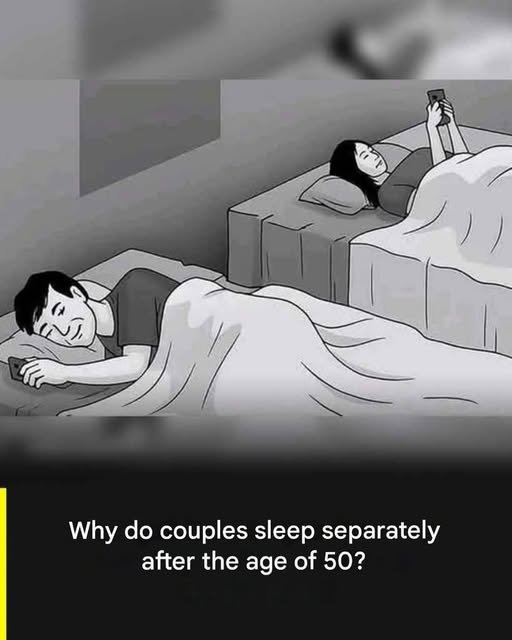
7 Surprising Reasons Couples Sleep Separately After 50 (And Why It Might Save Their Relationship)
Discover why couples over 50 choose separate beds—and how it can improve sleep, health, and relationship satisfaction.
It often starts quietly.
One partner begins waking up at 3 a.m. The other tosses and turns. Someone starts snoring louder than they used to. Blankets get stolen. Sleep becomes…work.
Then one night, someone says it:
“Maybe we should try sleeping in separate rooms.”
For many couples over 50, that moment feels loaded—with doubt, fear, even guilt. Isn’t sharing a bed part of being close?
Here’s the twist: for a growing number of long-term couples, sleeping separately isn’t a sign of distance—it’s a strategy for staying connected.
In this deep dive, you’ll uncover why couples over 50 are making this shift, what it actually means for relationships, and how to decide if it’s right for you—without damaging intimacy or emotional closeness.
The Quiet Shift: What’s Really Happening?
Sleeping separately—sometimes called a “sleep divorce”—is becoming more common, especially in the United States.
And it’s not just anecdotal.
Sleep experts and relationship counselors increasingly acknowledge that shared sleep doesn’t always equal better sleep—or a stronger bond.
By midlife, the body changes. Routines change. Even emotional needs evolve. The bedroom, once a place of rest and connection, can turn into a battleground of mismatched sleep patterns.
So couples adapt.
Not because they’re drifting apart—but because they’re trying to function better together.
Why It Matters (More Than You Think)
Sleep isn’t just about feeling rested.
Chronic sleep disruption is linked to:
- Increased risk of heart disease
- Weakened immune function
- Memory issues
- Irritability and mood swings
Now layer that onto a long-term relationship.
Poor sleep can quietly erode patience, communication, and emotional availability.
In other words:
Sleeping poorly together can damage your relationship more than sleeping well apart.
7 Core Reasons Couples Over 50 Choose Separate Sleeping
1. Sleep Becomes Lighter—and Easier to Disrupt
As people age, deep sleep decreases. You wake more easily.
That small movement? That cough? That shift in blankets?
It’s enough to wake you up—and keep you up.
Over time, this creates a pattern: one partner becomes hyper-aware of the other’s presence, even subconsciously.
Separate sleeping becomes less about preference… and more about survival.
2. Snoring and Sleep Apnea Increase
Let’s be blunt—snoring gets worse with age.
For many couples, it’s not just annoying. It’s relentless.
And in some cases, it’s tied to conditions like sleep apnea, which can cause:
- Loud snoring
- Gasping during sleep
- Repeated awakenings
This doesn’t just affect the person with the condition—it disrupts the partner’s sleep cycle too.
Moving to separate rooms often brings immediate relief to both people.
3. Different Sleep Schedules (Chronotype Shift)
One partner becomes an early riser. The other stays up later.
This mismatch—known as differing chronotypes—tends to widen after 50.
Examples:
- One wakes at 5 a.m. energized
- The other hits peak alertness at 10 p.m.
Trying to force alignment can lead to frustration and poor sleep for both.
Separate sleeping allows each person to follow their natural rhythm without compromise.
4. Hormonal Changes Affect Sleep
For women, menopause brings a major shift:
- Night sweats
- Hot flashes
- Restlessness
For men, testosterone levels decline, which can affect sleep quality and increase nighttime awakenings.
These biological changes create unpredictable sleep patterns that are hard to synchronize.
Separate sleeping becomes a practical way to cope—without constant disruption.
5. Health Conditions and Medications
By 50+, it’s common for one or both partners to manage chronic conditions.
These may require:
- Frequent bathroom trips
- Medication schedules
- Position adjustments for pain
Even something as simple as getting in and out of bed repeatedly can wake the other person.
Sleeping separately can reduce friction and allow both partners to manage their needs independently.
6. Personal Space Becomes More Valuable
After decades of shared routines, many couples begin to crave a bit of autonomy.
Not emotional distance—just breathing room.
Separate sleeping offers:
- A sense of control
- Personalized environments (temperature, lighting, mattress type)
- Mental decompression
It’s less about separation—and more about reclaiming individuality within the relationship.
7. Better Sleep = Better Relationship
This is the most overlooked reason.
When both partners are well-rested:
- Communication improves
- Conflict decreases
- Emotional resilience increases
Couples often report feeling closer, not further apart, after making the switch.
Because they’re no longer exhausted versions of themselves.
Real-Life Scenario: The Johnsons
Mark (62) and Linda (59) had been married for 34 years.
Mark snored. Loudly. Linda developed insomnia during menopause.
For years, they powered through—resentment quietly building.
Finally, Linda moved into the guest room “temporarily.”
Within a week:
- She slept through the night
- Mark stopped feeling guilty about snoring
- Their morning conversations improved
What surprised them most?
They started choosing to spend time together again—because they weren’t drained.
What began as a last resort became a long-term solution.
Step-by-Step: How to Transition Without Hurting Your Relationship
If you’re considering this shift, how you approach it matters.
Step 1: Start With the Right Conversation
Avoid framing it as rejection.
Instead, focus on shared goals:
- Better sleep
- Improved health
- More energy for each other
Step 2: Treat It as an Experiment
Try separate sleeping for 2–4 weeks.
This removes pressure and allows both partners to evaluate the impact.
Step 3: Maintain Emotional Connection
Sleeping apart doesn’t mean disconnecting.
Intentionally build in:
- Bedtime rituals together
- Morning check-ins
- Physical affection
Step 4: Create Comfortable Spaces
Make both sleeping areas inviting—not one “real” bedroom and one “backup.”
This reinforces equality and respect.
Step 5: Reassess Regularly
What works now might evolve.
Keep communication open.
Comparison: Sleeping Together vs. Sleeping Separately
| Factor | Sleeping Together | Sleeping Separately |
|---|---|---|
| Sleep Quality | Often disrupted | Typically improved |
| Emotional Connection | Can feel closer (if rested) | Can improve with intention |
| Convenience | Easier | Requires adjustment |
| Personal Comfort | Limited compromise | Fully customizable |
| Relationship Impact | Depends on sleep quality | Often positive long-term |
Pros and Cons (No Sugarcoating)
Pros
- Better sleep quality
- Reduced resentment
- Improved health
- Greater independence
- Enhanced daytime connection
Cons
- Initial emotional discomfort
- Social stigma (“Are we okay?”)
- Requires intentional intimacy
- Logistical adjustments
Common Mistakes (And How to Avoid Them)
Mistake 1: Not Talking About It Honestly
Fix: Be direct but empathetic. Avoid passive-aggressive changes.
Mistake 2: Letting Distance Replace Intimacy
Fix: Schedule connection—not just sleep.
Mistake 3: Treating It as a Relationship Failure
Fix: Reframe it as a strategic adaptation.
Mistake 4: One-Sided Decision
Fix: Both partners need to feel heard and respected.
Expert-Level Insights You Rarely Hear
- Sleep compatibility matters more than shared space after long-term cohabitation
- Many couples already “micro-separate” (different bedtimes, couch sleeping) without acknowledging it
- Emotional intimacy is driven more by quality interaction than physical proximity at night
Sleep is biological. Relationships are emotional. They don’t always align perfectly—and that’s okay.
2026 Trends: The Rise of “Sleep Compatibility”
In the U.S., more couples are openly discussing sleep as a relationship factor.
Trends include:
- Dual-bedroom home designs
- Customizable sleep environments
- Increased awareness of sleep disorders
The stigma is fading.
People are prioritizing function over tradition.
What the Future Looks Like
Expect this to become normalized.
Just like separate finances or remote work, separate sleeping is shifting from taboo to practical.
The strongest relationships aren’t rigid—they adapt.
❓ Frequently Asked Questions
1. Is sleeping separately a sign of relationship trouble?
Not necessarily. In many cases, it reflects problem-solving—not emotional distance.
2. Does it reduce intimacy?
It can if ignored—but with intention, many couples report improved intimacy.
3. How do you explain it to others?
You don’t have to. But if you do, frame it as a health and sleep decision.
4. Is it more common after 50?
Yes, due to biological and lifestyle changes affecting sleep patterns.
5. Can it actually improve a marriage?
Yes—especially if sleep issues were causing tension or resentment.
6. What if one partner resists?
Start with a trial period and focus on shared benefits, not personal complaints.
7. Should couples still spend time together at night?
Absolutely. Connection doesn’t have to disappear—just shift.
8. Is this backed by experts?
Sleep specialists and relationship therapists increasingly support individualized sleep arrangements.
9. Does it lead to emotional distance over time?
Only if communication and intentional connection are neglected.
10. Is it permanent?
Not always. Many couples adjust based on life stages and needs.
🧾 Action Checklist
What to Do
✔ Have an open, honest conversation
✔ Frame it around better sleep and health
✔ Try a temporary experiment
✔ Maintain daily emotional connection
✔ Create equally comfortable sleep spaces
✔ Revisit the arrangement regularly
What to Avoid
✘ Framing it as rejection
✘ Ignoring your partner’s feelings
✘ Letting intimacy fade
✘ Making sudden, unilateral decisions
✘ Assuming it means your relationship is failing
🏁 Conclusion
Sleeping separately after 50 isn’t about drifting apart.
It’s about adapting—intelligently, intentionally—to changing bodies, routines, and needs.
For many couples, it’s the difference between surviving the night… and actually enjoying the day together.
Because at the end of it all, the goal isn’t just to share a bed.
It’s to build a relationship that still works—decades in.
Sleeping separately doesn’t weaken a strong relationship—it often protects it.
If this gave you a new perspective, share it with someone who might need it—or drop your thoughts below.